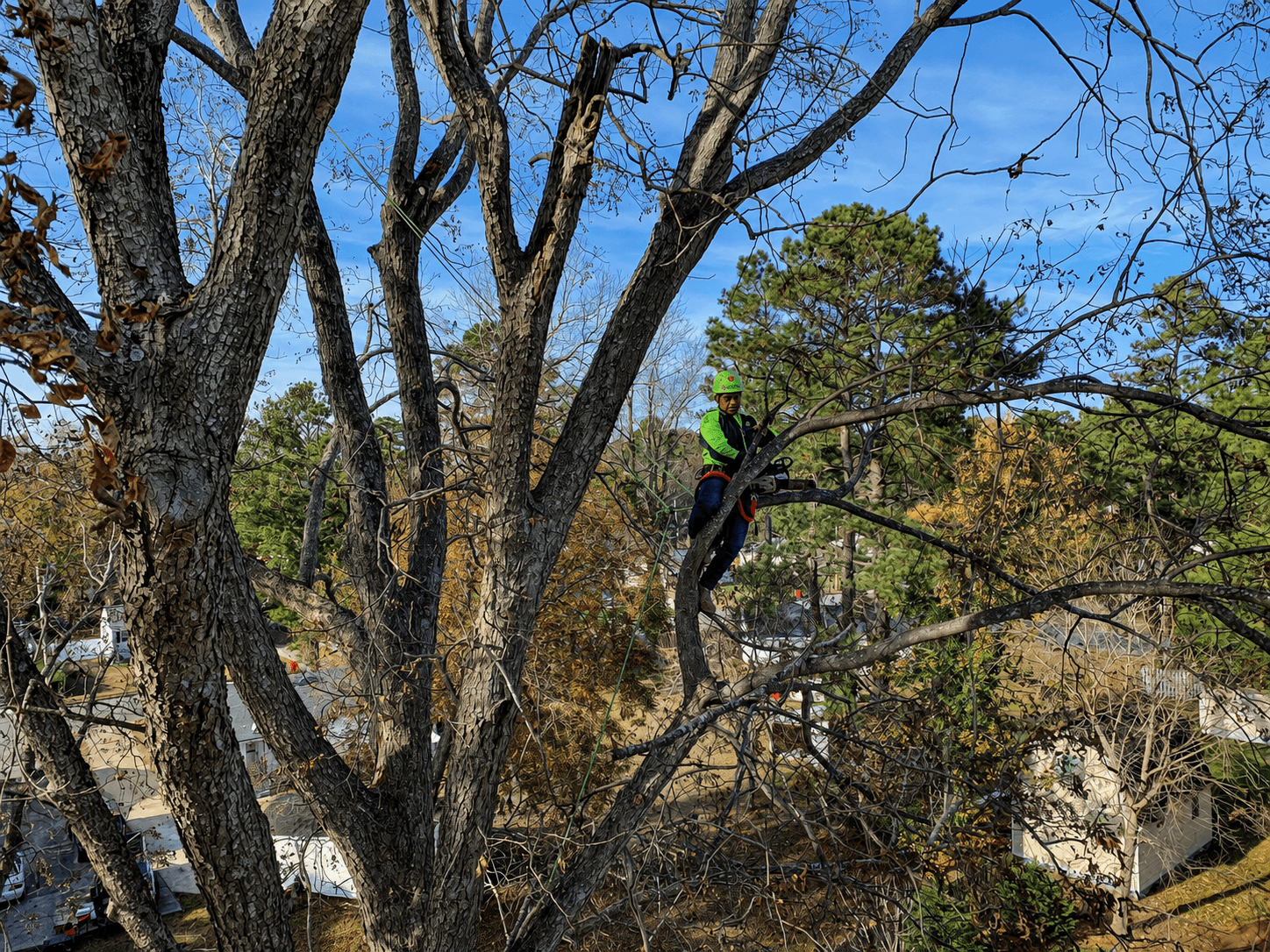
A useful pruning plan starts with the outcome the property needs, not an arbitrary season or a request to make the tree smaller.
Begin with a pruning objective
Pruning is a treatment, not a cosmetic default. The first question should be what the work needs to accomplish. A property may need clearance over a roof or driveway, removal of dead or broken branches, improvement of a young tree's structure, reduction of weight on a particular limb, or better separation from a nearby target. Each objective calls for different cuts and a different amount of work.
Vague directions such as “thin it out,” “take the top down,” or “make it smaller” leave too much room for interpretation. A stronger scope identifies the area of the canopy involved, the reason for the cuts, and the result the client should expect. If the objective cannot be explained in plain language, the work is not ready to begin.
Timing depends on the tree and the goal
There is no single pruning month that is right for every tree. Species, age, condition, flowering or fruiting cycle, pest pressure, the size of the proposed cuts, and the reason for pruning all matter. Work intended to guide structure can often be scheduled for a preferred season; a damaged branch over an occupied area may require a faster response.
Weather on the workday matters too. High winds, saturated ground, lightning, extreme heat, and poor access can change whether a planned operation is safe or whether equipment can enter without damaging the property. Responsible scheduling considers the tree's biological response and the conditions required to perform the work well.
Coastal exposure changes the conversation
Outer Banks trees live with persistent wind, salt spray, sandy or disturbed soils, episodic flooding, and rapid changes in exposure when nearby vegetation is removed. Those conditions can shape canopy form and affect how a tree allocates growth. The goal is not to force every tree into a symmetrical shape; it is to make purposeful cuts while respecting the structure the tree has developed on that site.
Coastal properties also create operational constraints. Narrow drives, septic areas, pools, decks, overhead utilities, neighboring homes, vacation-rental turnover, and landscape features can affect climbing, rigging, equipment placement, debris handling, and cleanup. The pruning prescription and the site plan should be developed together.
Deadwood, clearance, and structure are different scopes
Deadwood removal addresses branches that are no longer alive and may be likely to shed. Clearance pruning creates defined space from a roof, chimney, roadway, sign, or pedestrian route. Structural pruning manages specific branch relationships so the tree can develop or retain a more durable form. One visit may include more than one objective, but they should not be blended into a generic promise to “trim the tree.”
That distinction matters when comparing proposals. Two estimates can use similar language while describing very different amounts of canopy work. Ask which branches or canopy zones are included, whether the scope addresses a particular concern, and whether the proposed result is temporary clearance, long-term structure, or both.
Reduction is not topping
A qualified reduction shortens selected branches back to suitable lateral branches while retaining the tree's natural form and functional canopy. Topping indiscriminately cuts branches to stubs or to laterals too small to assume the terminal role. Topping creates large wounds, removes an excessive amount of leaf area, and often produces vigorous shoots with weak attachments.
If a tree must be repeatedly cut below its natural mature size to fit the site, the underlying conflict may not be solvable through pruning alone. The better long-term decision may be selective reduction, a phased plan, accepting the tree at its natural dimensions, or replacing it with a species suited to the available space.
More canopy removal is not automatically safer
Heavy interior stripping can leave foliage concentrated at branch ends, change load distribution, expose previously shaded bark, and reduce the tree's capacity to produce energy. Removing live canopy also causes a biological response. The amount that is appropriate depends on the tree, its condition, and the pruning objective rather than a standard percentage applied to every job.
A good recommendation is selective. It identifies the branches that matter, preserves useful live canopy, and avoids creating a new problem while trying to solve the original one. For mature or stressed trees, smaller interventions phased over time may be more responsible than a single aggressive visit.
What the written scope should tell you
Before work begins, the proposal should name the pruning objective, identify the tree or trees, describe the canopy areas involved, and clarify cleanup. For technical sites, it should also address access, equipment, traffic or pedestrian control, protection of roofs and landscaping, and any coordination needed with neighbors, managers, or utilities.
Ask what will look different when the crew is finished and what will intentionally remain. That conversation is especially important when a valuable tree has an asymmetrical form, when clearance must be maintained without over-pruning, or when the work is part of a multi-year plan.
When to request an on-site assessment
Schedule a closer look when the requested pruning involves large limbs, branches over occupied areas, a recent change in lean or canopy condition, visible cracking, root-zone disturbance, storm damage, or a disagreement about whether pruning can resolve the concern. Photos can help begin the conversation, but they rarely show the full branch attachment, root plate, targets, and access conditions.
If a branch is contacting or close to an overhead electrical conductor, do not attempt to prune it, move it, or use a ladder nearby. Contact the utility owner and a qualified tree-care professional so the electrical hazard and the tree work can be coordinated appropriately.